How to Inject GLP-1 in Thigh: Step-by-Step Guide 2026
GLP-1 medications have become an important treatment option for people managing type 2 diabetes, obesity, and weight-related health concerns. While these medications can offer meaningful benefits, learning how to administer injections correctly is essential for safe and consistent treatment. One common question among beginners is how to inject GLP-1 in thigh without unnecessary pain, bruising, or confusion.
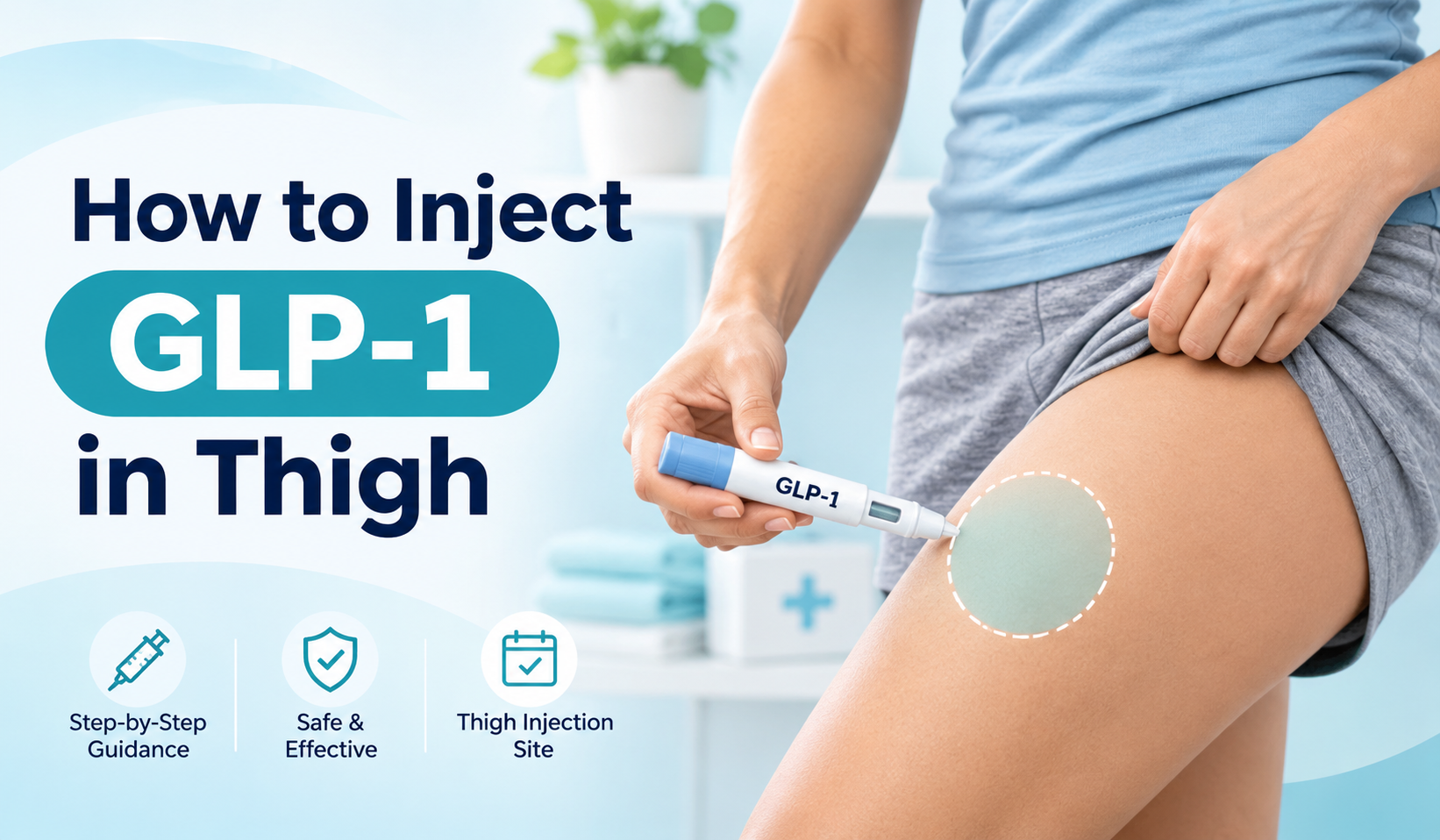
The thigh is an approved injection site for several injectable medications, including Ozempic, Wegovy, Mounjaro, and Zepbound.
It is easily accessible, making it a convenient choice for people who administer their medication at home. Understanding proper injection placement, preparation, technique, and site rotation can make the process more manageable.
This comprehensive guide explains where to inject GLP-1 in the thigh, how to prepare for an injection, common mistakes to avoid, and practical tips for a more comfortable experience.
 GLP-1 Starting at $59 Per Month – 100% Online
What Is a GLP-1 Injection?
GLP-1 stands for glucagon-like peptide-1, a naturally occurring hormone involved in blood sugar regulation, appetite signaling, and digestion.
GLP-1 receptor agonist medications mimic some actions of this hormone, helping regulate blood glucose and reduce hunger. Depending on the medication, they may also support weight management and other approved health outcomes.
Common injectable GLP-1 medications include:
-
Ozempic (semaglutide): Primarily prescribed for type 2 diabetes, with additional approved indications.
-
Wegovy (semaglutide): Used for chronic weight management and certain other approved conditions.
-
Trulicity (dulaglutide): Used in type 2 diabetes management.
-
Victoza (liraglutide): A daily injectable GLP-1 medication.
Mounjaro and Zepbound contain tirzepatide, which activates both GIP and GLP-1 receptors.
These medications are generally administered through subcutaneous injection, meaning the medicine is delivered into the fatty tissue beneath the skin rather than directly into a muscle or vein.
The thigh is one of several approved injection areas, alongside the abdomen and upper arm.
Can You Inject GLP-1 in Your Thigh?
Yes, the thigh is an approved injection site for many injectable GLP-1 medications. Manufacturers commonly recommend the front of the upper thigh as a suitable location for self-injection.
This area provides access to subcutaneous tissue, allowing the medication to be absorbed into the bloodstream.
The thigh is particularly convenient for people who prefer to remain seated while administering their medication or who find abdominal injections uncomfortable.
Potential advantages include:
-
Easy access without assistance.
-
Good visibility of the injection area.
-
Comfortable positioning while seated.
-
An alternative to abdominal injections.
-
Flexibility when rotating injection locations.
Correct placement matters more than choosing a particular side of the body. Both thighs can be used when following your medication’s instructions.
GLP-1 Starting at $59 Per Month – 100% Online
Where to Inject GLP-1 in the Thigh
Choosing the correct injection location is one of the most important parts of safe administration.
For most commonly used GLP-1 injection pens, the recommended thigh location is the front of the upper leg, where there is enough suitable tissue beneath the skin.
Imagine dividing the distance between your hip and knee into three sections. The middle portion of the front thigh provides a general reference area, but the injection-site illustration supplied with your medication should determine the exact boundaries.
Recommended thigh injection area
| Injection area | Recommendation |
|---|---|
| Front of upper thigh | Commonly recommended |
| Middle portion of front thigh | Often a practical location within the approved area |
| Directly over the knee | Avoid |
| Inner thigh | Not a standard recommended site |
| Bruised or irritated skin | Avoid |
| Scarred or hardened tissue | Choose another location |
Avoid injecting into areas with visible irritation, tenderness, swelling, bruising, or damaged skin.
The FDA-approved instructions for Wegovy specifically identify the front of the upper thigh as an injection location and recommend avoiding tender, bruised, red, or hardened areas.
How to Inject GLP-1 in Thigh: Step-by-Step Instructions
Learning how to give yourself a GLP-1 injection becomes easier when you follow a consistent routine.
The following steps describe general preparation and safe injection practices. Always follow the instructions for your specific medication and device, because Ozempic, Wegovy, Zepbound, and vial-based injections operate differently.
Step 1: Gather your injection supplies
Before starting, prepare everything you need.
Your supplies may include your prescribed GLP-1 medication, the correct injection pen or syringe, an alcohol swab, clean gauze, and an approved sharps disposal container.
Check the medication name, prescribed dose, expiration date, and appearance of the solution.
Do not use medication that appears damaged, has been improperly stored, or looks different from the description in its instructions.
Wash your hands thoroughly with soap and water before handling your injection equipment.
Step 2: Choose a comfortable sitting position
Sit on a stable chair with both feet resting comfortably on the floor.
Expose the upper thigh and relax your leg muscles. Sitting makes it easier to see the injection location and maintain a steady position throughout the process.
Avoid tightening your thigh muscles unnecessarily.
Choose a location with good lighting so you can clearly observe your injection device.
Step 3: Select the injection site
Look at the front of your upper thigh and locate an appropriate area within the region shown in your medication’s instructions.
Inspect the skin for redness, bruising, swelling, scars, or unusual tenderness.
Select a different location if the skin appears irritated.
If you injected into your right thigh previously, you may choose your left thigh or a different spot within the approved region.
Step 4: Clean the skin
Use an alcohol swab to clean the selected injection area, following the instructions for your medication.
Allow the skin to dry completely before continuing.
Avoid touching the cleaned area with your fingers.
Injecting before the alcohol dries can contribute to stinging, so allowing adequate drying time may improve comfort.
Step 5: Prepare the GLP-1 injection device
Preparation depends on the type of injection system.
For example, some prefilled pens require attaching a new needle and selecting the prescribed dose. Other devices are single-use autoinjectors with a hidden needle and a preset dose.
Some medications are also supplied in vials and require a separate syringe.
Read the manufacturer’s instructions carefully. Do not assume that instructions for one GLP-1 device apply to another.
If you have not been trained to prepare your specific device, ask your pharmacist or healthcare professional for a demonstration.
Step 6: Administer the injection
Position the device against the approved thigh injection site as directed by the manufacturer.
For many pen devices, this involves holding the pen perpendicular to the skin. Syringe technique and the need to pinch the skin can differ depending on the prescribed product, needle length, and patient.
Activate the device exactly as instructed.
Keep the pen or needle in place until the medication delivery process is complete.
For example, the Ozempic multidose pen instructions direct users to keep the dose button pressed and count slowly to six after the dose counter reaches zero. The U.S. Wegovy single-dose pen uses a moving yellow indicator bar to show injection progress.
Step 7: Remove the device carefully
Once the injection is complete, remove the pen or syringe following its instructions.
If a small amount of blood appears, gently press the area with clean gauze or cotton.
Avoid rubbing or massaging the injection site.
A tiny spot of blood or mild temporary discomfort can occur after a subcutaneous injection.
If medication appears to have leaked because the device was removed too early, contact your pharmacist or prescriber before deciding whether another dose is needed.
Step 8: Dispose of the needle or pen safely
Place used needles, syringes, or single-use injection pens containing needles directly into an appropriate sharps disposal container.
Never place loose needles into ordinary household trash or recycling.
If an FDA-cleared sharps container is unavailable, the FDA describes specific requirements for a suitable heavy-duty plastic household container. Disposal rules may vary by location.
GLP-1 Starting at $59 Per Month – 100% Online
Does Injecting GLP-1 in the Thigh Hurt?
Most people experience only brief discomfort from subcutaneous GLP-1 injections, although sensitivity varies.
Some people describe the sensation as a small pinch, while others notice mild stinging or temporary tenderness.
Several factors can influence injection comfort, including skin sensitivity, injection location, muscle tension, needle technique, and the device being used.
Tips to make thigh injections more comfortable
-
Relax your leg: Avoid tightening the thigh muscles before or during the injection.
-
Allow alcohol to dry: Wet alcohol may cause a stinging sensation.
-
Avoid sensitive skin: Choose areas without existing bruising or irritation.
-
Use the correct technique: Follow the device’s instructions and complete the injection before removing it.
-
Rotate injection spots: Avoid repeatedly injecting into the same small area.
-
Check medication storage instructions: Some products permit a period at room temperature before injection, while others have different requirements.
Never heat medication using hot water, a microwave, or direct sunlight.
If injections are consistently painful, ask your healthcare professional to review your technique.
Thigh vs. Stomach: Which GLP-1 Injection Site Is Better?
Both the thigh and abdomen are commonly approved injection areas for GLP-1 medications.
The best choice depends on personal comfort, ease of access, the medication’s instructions, and advice from your healthcare professional.
| Feature | Thigh injection | Stomach injection |
|---|---|---|
| Accessibility | Easy while seated | Easy while sitting or standing |
| Visibility | Usually excellent | Usually excellent |
| Self-injection | Convenient | Convenient |
| Comfort | Depends on individual sensitivity | Depends on individual sensitivity |
| Site rotation | Both thighs provide options | Multiple suitable abdominal spots |
| Effectiveness | Effective when administered correctly | Effective when administered correctly |
For many GLP-1 medications, both locations provide adequate absorption for the intended treatment.
There is no established general rule that thigh injections produce greater weight loss than abdominal injections.
Selecting a recommended location and using correct technique are more important than trying to optimize results by choosing one body area.
GLP-1 Starting at $59 Per Month – 100% Online
How Often Should You Rotate GLP-1 Thigh Injection Sites?
Injection-site rotation is an important part of maintaining healthy skin during ongoing treatment.
Repeatedly injecting into the exact same location can contribute to irritation and changes in the tissue beneath the skin.
For medications administered weekly, consider keeping a simple record of where each injection was given.
For example:
| Injection | Location |
|---|---|
| Week 1 | Right front thigh |
| Week 2 | Left front thigh |
| Week 3 | Different spot on right front thigh |
| Week 4 | Different spot on left front thigh |
This is an example rather than a mandatory schedule. You can also rotate between other approved body areas.
For daily GLP-1 injections, choose a different appropriate spot with each dose.
The essential rule is to avoid using the exact same injection point repeatedly.
Common Mistakes to Avoid When Injecting GLP-1 in the Thigh
Even experienced users can make injection mistakes, particularly when switching medications or devices.
Injecting into muscle instead of fatty tissue
GLP-1 medications intended for subcutaneous use should be delivered beneath the skin, not directly into muscle.
Using the recommended site and the correct device helps ensure proper administration.
Repeatedly choosing the same spot
Injecting in one location over and over may contribute to soreness or tissue changes.
Rotate within the recommended injection area.
Removing the pen too early
Some injection devices require several seconds to complete medication delivery.
Removing the pen prematurely can result in an incomplete dose.
Follow the completion indicator or timing described in your device instructions.
Injecting into damaged skin
Avoid areas containing bruises, redness, swelling, or hardened tissue.
Healthy skin provides a more appropriate location for routine injections.
Using the wrong dose
Never estimate GLP-1 doses or change your prescribed amount without medical guidance.
Different medications and formulations may use different dose measurements and delivery devices.
This is especially important for compounded medications supplied in vials, where confusion between milligrams, milliliters, and syringe units can cause serious dosing errors.
GLP-1 Starting at $59 Per Month – 100% Online
What Happens After a GLP-1 Thigh Injection?
After a properly administered injection, the medication gradually enters the bloodstream through subcutaneous tissue.
You generally do not need to remain seated afterward unless you feel uncomfortable.
Most people can continue their usual daily activities.
Some individuals notice mild localized reactions such as temporary redness, itching, soreness, or small areas of swelling.
These reactions are often short-lived.
GLP-1 medications can also cause digestive side effects, including nausea, vomiting, constipation, diarrhea, or abdominal discomfort. Such symptoms may occur regardless of whether the medicine is injected into the thigh or abdomen.
Contact your healthcare professional if an injection-site reaction becomes increasingly painful, warm, swollen, or develops drainage.
Seek urgent medical care for symptoms of a serious allergic reaction, such as difficulty breathing, swelling of the face or throat, or widespread hives accompanied by dizziness.
Can You Inject GLP-1 in the Same Thigh Every Week?
Yes, for many GLP-1 medications, you may use the same thigh from week to week as long as you choose a different injection point each time.
You do not necessarily need to alternate between the left and right thighs.
The important consideration is preventing repeated injections into the exact same small area.
You might prefer using one thigh because it is easier to reach or because the other thigh is sensitive.
If you develop recurring bruising or discomfort, consider using another approved location after reviewing the manufacturer’s instructions.
GLP-1 Starting at $59 Per Month – 100% Online
Does Injecting GLP-1 in the Thigh Help With Weight Loss?
GLP-1 medications support weight management through their effects on appetite regulation, fullness, and other metabolic processes.
Injecting into the thigh does not directly target thigh fat or cause localized fat loss.
When prescribed for weight management, the medication works throughout the body rather than only at the injection location.
Results depend on several factors, including the specific medication, prescribed dose, individual response, nutrition, physical activity, and treatment consistency.
The purpose of selecting the thigh is to provide a suitable route for medication administration, not to change where body fat is reduced.
When Should You Avoid Injecting GLP-1 Into Your Thigh?
The thigh may not be an appropriate injection location if the intended area has:
-
Active skin infection or inflammation.
-
Significant bruising or tenderness.
-
Open wounds or damaged skin.
-
Unusual swelling or hardened tissue.
-
Scars that interfere with safe injection.
-
A persistent reaction from a previous injection.
Choose another approved site if necessary.
People with reduced skin sensation, mobility limitations, or difficulty handling injection equipment may benefit from additional instruction or assistance.
If you are unsure whether a particular site is appropriate, consult your healthcare professional.
Final Verdict
Learning how to inject GLP-1 in thigh can make treatment easier, particularly for people who prefer a visible and accessible self-injection location. The front of the upper thigh is an approved site for several popular GLP-1 medications, including Ozempic and Wegovy, as well as tirzepatide products such as Zepbound.
Successful injections begin with selecting healthy skin, preparing the medication correctly, following the specific device instructions, and allowing the full dose to be delivered. Rotating injection locations and using proper sharps disposal practices also help support long-term treatment safety.
Whether you prefer the thigh, abdomen, or another approved injection site, consistency and proper technique are essential. Always follow your prescribed treatment plan and seek a demonstration from your healthcare professional if you are new to self-injections.
GLP-1 Starting at $59 Per Month – 100% Online
References
https://www.healthline.com/health/drugs/glp-1-injection-sites
