Where to Inject GLP-1: Step-by-Step Guide
GLP-1 medications have become an important treatment option for people managing type 2 diabetes, obesity, and certain weight-related health conditions. These medications help regulate appetite, improve blood sugar control, and support weight management when prescribed appropriately.
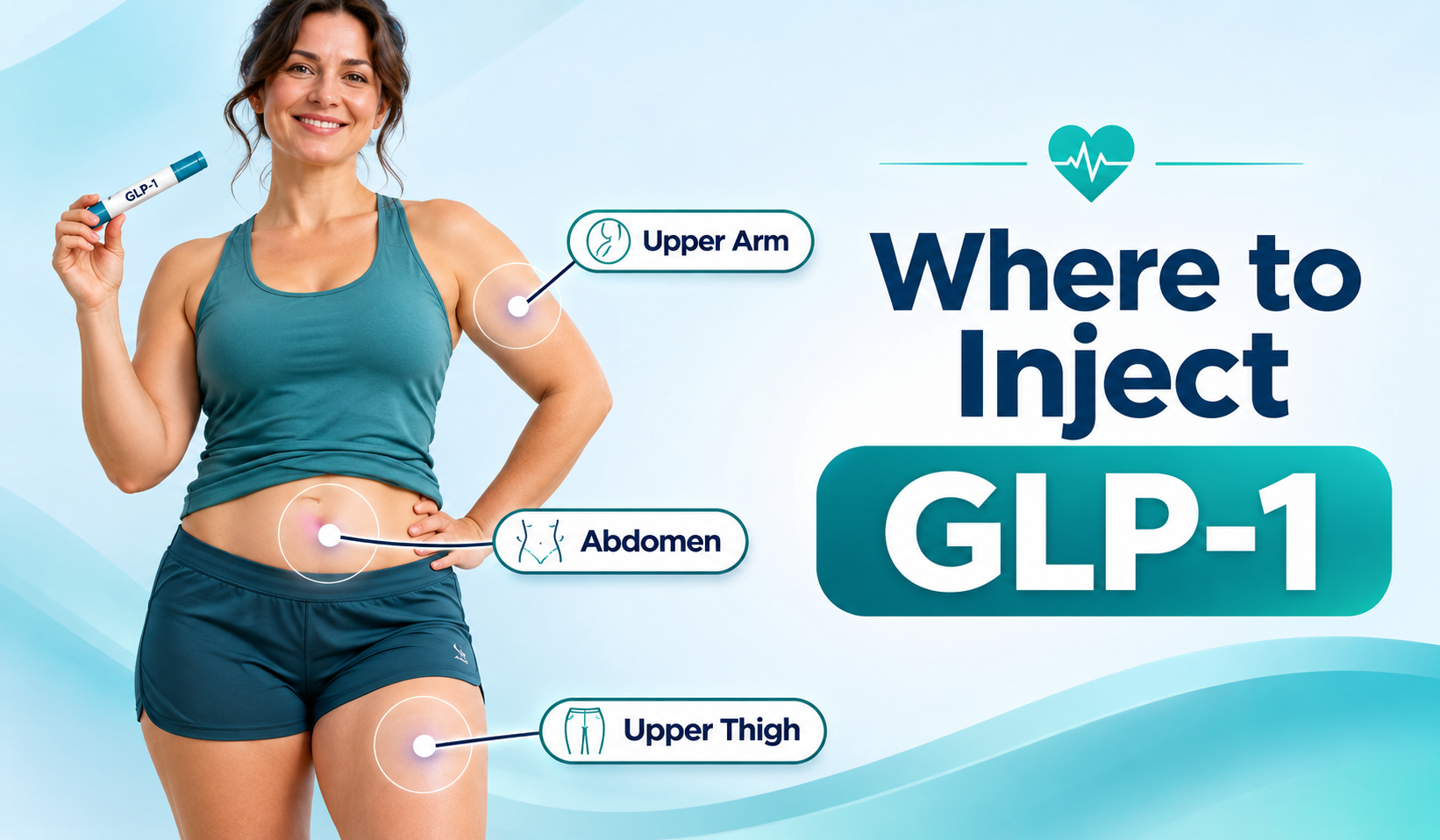
If you’re starting an injectable GLP-1 medication, one of the most common questions is where to inject GLP-1 for the best results. Choosing the correct injection site is essential for comfortable administration, consistent medication delivery, and reducing skin irritation.
The good news is that most injectable GLP-1 medications are designed for convenient administration at home. Common injection sites include the stomach, thighs, and upper arms. Each location has specific advantages, and understanding how to use them correctly can make your treatment routine easier.
This comprehensive guide explains the best places to inject GLP-1 medications, how to administer injections safely, where to avoid injecting, and how to rotate injection sites for a comfortable experience.
 GLP-1 Starting at $59 Per Month – 100% Online
What Are GLP-1 Injections?
GLP-1 injections are medications that imitate the activity of glucagon-like peptide-1, a naturally occurring hormone involved in blood sugar regulation and appetite control.
After eating, the body releases GLP-1 to help stimulate insulin production when blood glucose rises. This hormone also slows stomach emptying and influences appetite signals in the brain.
Prescription GLP-1 receptor agonists enhance these physiological processes, helping patients manage blood glucose and, with certain medications, achieve meaningful weight loss.
Common injectable medications include:
-
Ozempic (semaglutide): A once-weekly medication primarily prescribed for type 2 diabetes and certain associated risks.
-
Wegovy (semaglutide): Used for chronic weight management and certain other approved indications.
-
Mounjaro (tirzepatide): A once-weekly dual GIP and GLP-1 receptor agonist prescribed for type 2 diabetes.
-
Zepbound (tirzepatide): A dual GIP and GLP-1 receptor agonist used for chronic weight management and certain other approved indications.
-
Victoza (liraglutide): A GLP-1 medication administered daily for type 2 diabetes.
Although these medications share similarities, their dosing schedules, injection devices, and instructions may differ.
Most are injected into the fatty tissue directly beneath the skin, a technique called a subcutaneous injection.
Where to Inject GLP-1? Three Recommended Injection Sites
The three standard injection areas for many GLP-1 medications are the abdomen, thigh, and upper arm.
Each site allows the medication to enter the subcutaneous tissue, from which it is gradually absorbed into circulation.
1. Abdomen (Stomach Area)
The abdomen is a convenient injection site for many patients because it is easily accessible and usually contains enough subcutaneous fatty tissue for comfortable administration.
For medications such as Wegovy, instructions specify injecting at least two inches away from the belly button.
Benefits of injecting GLP-1 into the stomach:
-
Easy to reach without assistance.
-
Convenient for people administering injections independently.
-
Provides several possible locations for site rotation.
-
Allows a clear view of the injection area.
-
Often fits naturally into a regular medication routine.
Choose an area of healthy skin and avoid bruises, scars, stretch marks, irritated areas, or unusual lumps.
While the stomach is a popular choice, it is not necessarily more effective than other approved injection sites.
2. Thigh (Upper Leg)
The thigh is another recommended location for many injectable GLP-1 medications.
Most product instructions direct patients toward the front of the thigh, where the injection can be administered into the subcutaneous tissue.
This area is especially convenient for people who prefer to sit while administering their medication.
Benefits of injecting GLP-1 into the thigh:
-
Accessible while sitting comfortably.
-
Easy to inspect before administering medication.
-
Provides an alternative to abdominal injections.
-
Convenient for alternating between the left and right legs.
-
May feel more comfortable for patients who prefer to avoid stomach injections.
Choose an approved location on the front of your upper leg and avoid areas with bruising, swelling, redness, or tenderness.
Some patients find thigh injections more noticeable than abdominal injections, but individual experiences vary.
3. Upper Arm
The upper arm is also an approved injection area for many GLP-1 medications.
Depending on the product, the recommended location is the back of the upper arm, where there is suitable subcutaneous tissue.
For Zepbound, the manufacturer instructs that another person should administer injections into the back of the upper arm.
Benefits of upper-arm injections:
-
Offers another location for injection-site rotation.
-
Useful when the abdomen or thighs are uncomfortable.
-
Can be convenient when a caregiver assists with injections.
-
Helps avoid repeatedly using the same area of skin.
Self-injecting the upper arm can be difficult because reaching the correct location while maintaining proper device positioning may be challenging.
Always follow your specific medication’s instructions regarding assisted administration.
GLP-1 Starting at $59 Per Month – 100% Online
Which Is the Best Place to Inject GLP-1 for Weight Loss?
Many people wonder whether injecting GLP-1 into the stomach, thigh, or arm produces better weight-loss results.
For approved injectable GLP-1 medications, there is no established advantage of one recommended injection site over another for achieving greater weight loss.
The medication works throughout the body after entering the bloodstream. Its effects on appetite regulation, gastric emptying, and metabolic function are not restricted to the area where it was administered.
The best injection site is generally the one that:
-
Is approved for your prescribed medication.
-
Allows you to administer the injection correctly.
-
Has healthy, uninjured skin.
-
Is easy to access and inspect.
-
Can be rotated consistently.
-
Feels comfortable during administration.
For many patients, the abdomen offers the easiest access. Others prefer the thigh because they can inject while seated.
The most important factors affecting treatment outcomes include taking the prescribed medication consistently, following dose instructions, and maintaining appropriate dietary and physical activity habits.
How to Inject GLP-1 Properly: Step-by-Step Guide
Understanding the correct injection process helps minimize mistakes and supports safe medication administration.
Injection techniques vary between single-dose pens, multidose pens, prefilled syringes, and vials. Always use the Instructions for Use supplied with your exact product.
Step 1: Gather Your Supplies
Before beginning, prepare everything required for your particular medication.
This may include your prescribed injection pen or vial, a compatible new needle or syringe, an alcohol swab, gauze, and a suitable sharps disposal container.
Wash your hands thoroughly with soap and water.
Confirm that the medication name, prescribed dose, expiration date, and appearance match the manufacturer’s instructions.
Step 2: Choose an Appropriate Injection Site
Select an approved area on your abdomen, thigh, or upper arm.
Make sure the skin is healthy and free from redness, swelling, wounds, bruises, or unusual thickening.
Avoid using the exact location of your previous injection.
Step 3: Clean the Skin
Clean the chosen injection area using an alcohol swab or the cleaning method specified by the manufacturer.
Allow the skin to dry completely before administering the medication.
Avoid touching the cleaned area unnecessarily.
Step 4: Prepare the Injection Device
Follow the specific directions for your prescribed injection device.
Some pens require attaching a new needle, checking medication flow, and selecting a dose. Other devices contain a predetermined dose and use a different activation process.
Do not assume that instructions for one GLP-1 pen also apply to another.
If your medication comes in a vial, obtain training on the correct syringe and dose measurement before injecting.
Step 5: Administer the Medication
Position the device against or into the skin as instructed by the manufacturer.
Some devices require pressing a button, while others activate when firmly positioned against the injection site.
Keep the device in place for the required amount of time so the full prescribed dose can be delivered.
For example, the Ozempic pen instructions direct patients to keep pressing the dose button and count slowly to six after the dose counter reaches zero. Other devices use different procedures.
Step 6: Dispose of the Used Needle or Pen Safely
Once the injection is complete, dispose of used needles or single-use devices as directed.
Place used sharps in an FDA-cleared sharps disposal container when available.
Never share injection needles, syringes, or pens with another person, even if the needle has been changed.
GLP-1 Starting at $59 Per Month – 100% Online
Where Should You Avoid Injecting GLP-1?
Choosing a healthy injection location is just as important as selecting an approved body area.
Avoid administering GLP-1 medication into:
-
Bruised skin: Bruising may increase discomfort and make it difficult to assess the site.
-
Scar tissue: Scarred areas may affect consistent medication absorption.
-
Red or inflamed skin: Irritated tissue can become more uncomfortable after injection.
-
Hard lumps or thickened skin: Repeated injections into affected tissue may interfere with predictable absorption.
-
Cuts and open wounds: Damaged skin should be allowed to heal.
-
Tender or swollen areas: Choose a different healthy location.
-
Unapproved body areas: Do not inject into the buttocks, hands, calves, or other locations unless explicitly directed for your medication.
GLP-1 injections intended for subcutaneous administration must not be injected directly into a vein or muscle.
The manufacturer’s instructions for your prescription should always determine where the medication is administered.
Why Is Rotating GLP-1 Injection Sites Important?
Injection-site rotation means selecting a different injection location each time you administer the medication.
Repeatedly injecting into the exact same spot can contribute to local irritation, skin thickening, lumps, or other changes to the tissue.
Rotating sites gives previously used areas time to recover.
For example, a person taking a weekly medication might establish this routine:
| Week | Injection location |
|---|---|
| Week 1 | Left side of abdomen |
| Week 2 | Right side of abdomen |
| Week 3 | Left thigh |
| Week 4 | Right thigh |
| Week 5 | A new approved spot on the abdomen |
This is an illustrative schedule rather than a mandatory rotation plan.
You do not necessarily need to change body regions every week. Manufacturers generally allow patients to use the same overall area as long as the exact injection spot changes.
Keeping a simple injection log can help you remember which locations you have already used.
GLP-1 Starting at $59 Per Month – 100% Online
Does GLP-1 Injection Site Affect Absorption?
GLP-1 medications are developed to provide predictable systemic effects when administered into approved subcutaneous injection areas.
Absorption characteristics can vary slightly between body sites, medications, and individuals, but these differences do not establish that one approved location consistently produces better clinical outcomes.
For example, semaglutide injections are approved for administration in the abdomen, thigh, or upper arm without changing the prescribed dose based on the injection location.
Likewise, tirzepatide products allow administration into recommended subcutaneous sites.
The goal is to administer the medication correctly and consistently rather than attempting to target a specific part of the body.
People experiencing unexpected side effects or treatment difficulties should speak with their prescribing healthcare professional instead of changing their dose or injection technique independently.
Does Injecting GLP-1 Into the Stomach Burn Belly Fat?
A common misconception is that injecting GLP-1 directly into abdominal fat will cause faster fat loss around the stomach.
GLP-1 injections do not work through targeted fat reduction.
These medications influence appetite, glucose regulation, and other physiological processes throughout the body.
Weight loss associated with treatment can involve reductions in fat tissue from different areas, including the abdomen, but the injection location does not determine where that fat is lost.
Injecting into the stomach does not specifically melt belly fat, and injecting into the thigh does not selectively reduce thigh fat.
Body composition changes depend on factors such as overall weight loss, genetics, nutrition, physical activity, and individual metabolic responses.
GLP-1 Starting at $59 Per Month – 100% Online
How to Make GLP-1 Injections Less Painful
Most subcutaneous GLP-1 injections involve a relatively small needle or a device designed for convenient use.
Still, some patients experience temporary stinging, pressure, or mild discomfort.
Several practical habits can make the process more comfortable.
Allow the Skin to Dry
If you clean your skin with an alcohol swab, let it dry completely before administering the injection.
Injecting while alcohol remains on the skin can contribute to a stinging sensation.
Relax Your Muscles
Choose a comfortable position that allows you to keep the injection area relaxed.
For thigh injections, sitting in a stable chair may be helpful.
Avoid Irritated Areas
Do not inject into skin that is already bruised, red, swollen, or tender.
Selecting healthy skin can reduce unnecessary discomfort.
Follow Medication Temperature Instructions
Some refrigerated injection products have instructions permitting them to reach room temperature before administration.
Follow the specific product guidance, because storage requirements and permitted waiting periods vary.
Do not microwave, freeze, or artificially heat the medication.
Rotate Injection Sites
Using different locations helps prevent repeated irritation in one area.
If injections repeatedly cause significant pain, ask your pharmacist or healthcare professional to review your technique.
Common GLP-1 Injection Mistakes to Avoid
Even experienced patients can occasionally make mistakes during medication administration.
Understanding common issues can help make injections safer and more consistent.
1. Repeatedly using the same injection spot
Using identical locations may contribute to irritation and skin changes. Rotate the exact injection location with each dose.
2. Injecting into bruised or damaged skin
Always inspect the chosen area before administering medication.
3. Using the wrong injection technique
Different pens and syringes have different operating instructions. Review the appropriate device instructions before use.
4. Removing the pen too early
Removing a device before the required injection time may result in an incomplete dose.
5. Reusing disposable needles
Needles intended for single use should not be reused, because reuse can increase contamination and injury risks.
6. Using an incorrect dose
Follow your prescribed dosage and titration schedule. Never increase medication independently to accelerate weight loss.
7. Improper medication storage
Temperature requirements differ by medication and device. Review the manufacturer’s storage guidance carefully.
If you are uncertain whether a full dose was delivered, contact your pharmacist or prescriber before attempting another injection.
GLP-1 Starting at $59 Per Month – 100% Online
GLP-1 Injection Side Effects at the Injection Site
Most injection-site reactions are mild and temporary.
Possible localized reactions include:
-
Mild redness around the injection area.
-
Temporary itching or tenderness.
-
Minor swelling.
-
Brief stinging or burning.
-
Small bruises.
-
Occasional localized bumps.
These reactions often improve without additional treatment.
Persistent pain, spreading redness, warmth, pus, fever, or worsening swelling may indicate an infection or another problem requiring medical evaluation.
Seek emergency medical attention if an injection is followed by difficulty breathing, severe facial or throat swelling, or other signs of a serious allergic reaction.
GLP-1 medications can also cause effects unrelated to the injection site, including nausea, vomiting, diarrhea, constipation, and abdominal discomfort.
Discuss severe or persistent symptoms with your healthcare professional.
How Often Should You Inject GLP-1?
The injection schedule depends on the specific medication prescribed.
Some medications are administered once weekly, while others are administered daily.
| Medication | Typical injection frequency |
|---|---|
| Ozempic (semaglutide) | Once weekly |
| Wegovy injection (semaglutide) | Once weekly |
| Mounjaro (tirzepatide) | Once weekly |
| Zepbound (tirzepatide) | Once weekly |
| Victoza (liraglutide) | Once daily |
| Saxenda (liraglutide) | Once daily |
| Trulicity (dulaglutide) | Once weekly |
Always follow your individual prescription rather than changing the schedule based on another medication’s instructions.
For weekly treatment, selecting a consistent day can help establish a reliable routine. If you miss a dose, follow your medication’s specific missed-dose instructions.
GLP-1 Starting at $59 Per Month – 100% Online
Can You Inject GLP-1 at Night?
Many weekly GLP-1 injections can be administered at any time of day, including morning, afternoon, or evening.
For medications such as Ozempic, Wegovy, and Zepbound, administration is not generally restricted to a particular hour.
Patients can select a time that fits their schedule, provided they follow the prescribed dosing frequency.
Some people prefer morning injections because they can easily remember them. Others choose evenings when they have fewer commitments.
There is no established evidence that injecting these medications at night consistently produces better weight-loss results.
The key is following the medication’s recommended schedule and maintaining treatment consistency.
Final Thoughts:
Choosing the correct GLP-1 injection site is an important part of administering your prescribed medication safely and comfortably.
For most commonly used injectable GLP-1 and dual GIP/GLP-1 medications, the abdomen, thigh, and upper arm are the primary recommended locations.
The stomach is often convenient for self-administration, while the thigh provides an accessible alternative. The upper arm may also be suitable, particularly when another person assists with the injection.
Regardless of which approved location you choose, rotating injection spots, avoiding damaged skin, and following the correct device instructions can help reduce discomfort and maintain reliable administration.
Ultimately, the best GLP-1 injection site is one that is appropriate for your prescribed medication and allows you to follow your treatment plan consistently.
Before your first injection, ask your healthcare professional to demonstrate the technique for your specific device.
GLP-1 Starting at $59 Per Month – 100% Online
References
https://www.healthline.com/health/drugs/glp-1-injection-sites
